
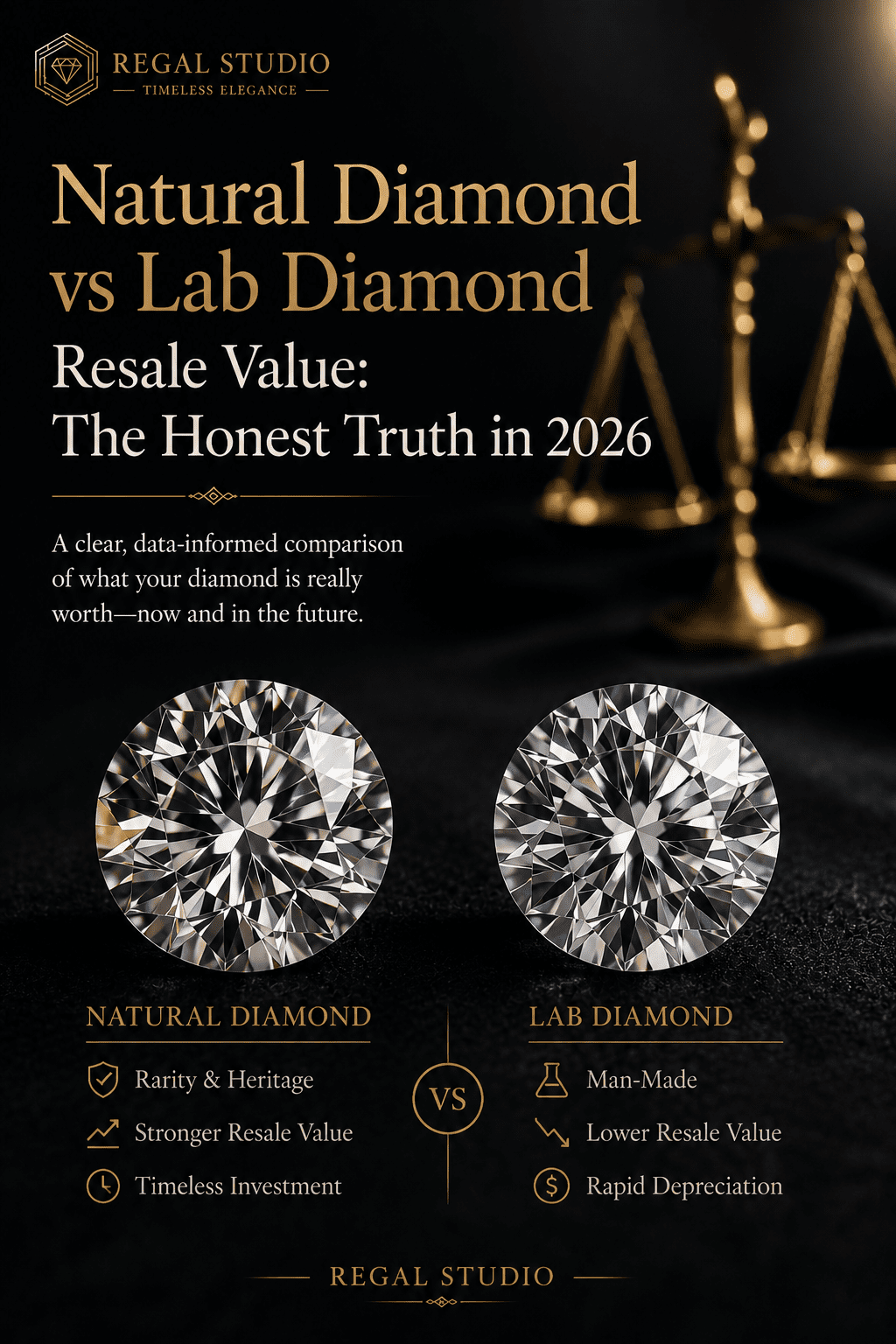


Natural Diamond vs Lab Diamond Resale Value: The Honest Truth in 2026
Quick answer: In 2026, a natural diamond typically resells for 25–50% of its original retail price through a reputable buyer, while a lab grown diamond usually fetches just 10–30%, and often less. Neither is a true investment, but natural diamonds hold value far better because their supply is limited, whereas lab grown prices keep falling as production scales. If resale matters to you, nature wins; if it does not, lab grown gives you far more beauty per dollar.
So before you spend thousands, here is the unvarnished truth from our bench, with real 2026 numbers and no sales spin.
A Note on Where This Analysis Comes From
This guide comes from Regal Studio in Buckhead, Atlanta. Our founder, Mack, is a GIA Certified Diamond Grader with over 45 years of experience.
We buy, sell, set, and appraise both natural and lab grown diamonds every week. We also field the resale question constantly.
So what follows is not recycled internet theory. It is what we actually see when a client brings a stone back to sell.
First, the Hard Truth: No Diamond Is an “Investment”
Let us clear this up before anything else. A diamond is not a financial instrument.
An investment pays you something. A stock pays dividends. A rental pays rent. A diamond pays you nothing while you own it.
Experience has shown that the smarter frame is “store of value.” A natural diamond behaves a bit like a Rolex or a fine handbag. It holds a meaningful slice of its worth. A lab grown diamond behaves more like a beautiful piece of technology that depreciates.
Even a natural diamond almost always resells for less than you paid. That is normal. The question is how much less.
Natural Diamond vs Lab Diamond Resale Value: The Real Numbers
Here is where the two stones genuinely diverge. We have cross-referenced multiple 2026 buyer and appraiser sources against what we see at our counter.
Resale Value Comparison Table (2026)
Factor | Natural Diamond | Lab Grown Diamond |
Typical resale (reputable buyer) | 25–50% of retail | 10–30% of retail |
Best-case resale (premium stone) | Up to 50–60% | Rarely above 30% |
Price trend | Stable for 18+ months | Still softening |
Supply | Naturally limited | Effectively unlimited |
Secondary market demand | Established | Thin and immature |
A key insight often overlooked: the lab grown resale figure is a moving target. Because new stones keep getting cheaper, a secondary buyer is competing against a falling retail price. That drags resale offers down further.
A Plain-English Example
Picture two buyers in 2021. Each spends $2,000 on a 1-carat diamond.
- The natural buyer might recover roughly $500–$1,000 today.
- The lab grown buyer might recover $200–$600, because that same lab stone now retails for around $800 new.
You are not just selling a used stone. You are selling against a cheaper new one.

Why Natural Diamonds Hold Value Better
This is not marketing. It comes down to basic economics and market structure.
1. Limited Supply
Natural diamonds formed over billions of years. Mining output is finite and tightly managed. Scarcity underpins value.
2. A Pricing Benchmark Exists
Natural diamonds trade against the globally accepted Rapaport price list. That gives buyers, sellers, and appraisers a shared reference point.
3. A Mature Secondary Market
Auction houses, estate buyers, and pawnbrokers have traded natural diamonds for over a century. The infrastructure to resell them is well established.
Why Lab Grown Resale Stays Low
The reasons are almost the mirror image.
- Unlimited supply. Factories can grow more whenever demand rises. Scarcity never enters the equation.
- No Rapaport equivalent. Lab grown has no universal pricing benchmark, so resale quotes are inconsistent.
- Falling new prices. Lab grown retail dropped roughly 85–90% from its peak. A used stone always competes with a cheaper new one.
- A thin secondary market. Few buyers actively want pre-owned lab stones, so offers stay low.
In our market observations, a small wrinkle exists: CVD lab stones sometimes resell slightly better than HPHT, because they often lack metallic inclusions and grade more cleanly. But the difference is marginal.
So Which Should You Actually Buy in 2026?
This is the real decision, and the honest answer depends entirely on why you are buying.
Choose Natural If…
- You see the ring partly as a financial safety net or family heirloom.
- You value heritage, tradition, and the “billion-year-old” story.
- Long-term value retention genuinely matters to you.
Choose Lab Grown If…
- You want the most beauty and size for your budget. A $3,000 budget buys roughly a 2-carat lab stone or a 0.5-carat natural one.
- You have no plans to ever resell it. For most couples, the ring stays on the finger, which makes resale academic.
- Ethics, sustainability, and transparent pricing rank high for you.
- You would rather spend the savings on a honeymoon, a home, or a safety net.
A key insight often overlooked: most engagement rings are never resold. If the stone stays in the family, resale value is a number you will never test.
The 2026 Market Context You Should Know
A few realities are shaping this decision right now.
- Lab grown diamonds now account for roughly 61% of US engagement ring center stones, up from 52% two years ago.
- Premium 1-carat lab rounds hit a functional price floor in late 2025. The era of double-digit annual drops is over.
- Natural diamond prices have stayed stable for 18+ months, with only modest fluctuations.
- A “3-Carat Standard” has emerged. Because large lab stones are so affordable, many couples now choose 2.5–3ct centers that were once ultra-luxury territory.
Experience has shown that as the lab market matures, resale may stabilize. But it is unlikely to ever rival natural, simply because supply is unlimited.
How to Protect Whatever Resale Value You Can
Whichever stone you choose, a few moves preserve value.
- Always get IGI or GIA certification. Uncertified stones resell for a fraction of certified ones.
- Prioritize cut quality. A brilliant cut commands stronger demand on the secondary market.
- Keep your paperwork. The original grading report and receipt matter at resale.
- Consider the setting. A platinum mount carries real scrap value independent of the stone.
- Buy from a trusted jeweler. Provenance and a relationship help when it is time to sell or trade up.

Frequently Asked Questions
What is the resale value of a natural diamond vs a lab diamond in 2026?
A natural diamond typically resells for 25–50% of its original retail price, sometimes up to 50–60% for premium stones. A lab grown diamond usually fetches 10–30%, and often less if lab prices have dropped since purchase.Do lab grown diamonds have any resale value at all?
Yes, but it is low and inconsistent. Expect 10–30% of what you paid, depending on size, cut, certification, and how far new prices have fallen since your purchase.Why do natural diamonds hold value better than lab grown?
Limited supply, an established pricing benchmark (Rapaport), and a mature century-old secondary market. Lab grown has unlimited supply, no universal benchmark, and a thin resale market.Are diamonds a good investment in 2026?
No. No diamond pays you a return. A natural diamond is better described as a “store of value” like a luxury watch, while a lab grown diamond depreciates more like consumer technology.Should I buy lab grown if I might resell later?
Generally no. If resale or value retention is a priority, natural is the safer choice. If you plan to keep the ring, lab grown delivers far more size and beauty for the money.
Get an Honest Resale Assessment in Atlanta
Resale value depends on your specific stone, its certification, and current demand. This is exactly where a real expert, not a sales pitch, makes the difference.
At Regal Studio in Buckhead, every piece is designed and handcrafted by Mack, a GIA Certified Diamond Grader with over 45 years of experience. Whether you are buying, selling, or trading up, we will give you a straight, transparent assessment of what your diamond is truly worth.
Our motto says it all: “You Dream It, We Make It.”
Visit Regal Studio on Peachtree Road in Buckhead, or get in touch to book a consultation. Let a seasoned master jeweler give you the honest numbers.
Read More:
Lab Grown Diamond Price Drop 2026: How Much Have Prices Actually Fallen?